

Break Apart Strategy For Subtraction
Welcome to the asynchronous module, Subtraction Strategies Progression. At your own pace, read through the materials, watch the curt video clips, and make sense of the pictures. This module is approximately 1 hour in length and can be completed in one sitting or in smaller parts. When you accept competed the module, click the link to the questionnaire in the box on the right. After successfully submitting the questionnaire, your contact hour certificate will automatically be emailed to the address provided in the questionnaire. If you lot should have whatsoever questions well-nigh this process or the content in this module, please contact Jen Robitaille at jennifer.r.robitaille@maine.gov.
Subtraction Strategies
Strategies are listed from the primeval strategies up through the standard algorithm. Many are used side past side, but it is important to understand that the variety of strategies are used to build a deeper conceptual understanding and movement to a more procedural model backed past conceptual understanding of subtraction. Keep in heed that mastery of the standard algorithm of subtraction is not expected until grade four per the Maine Learning Results and Mutual Cadre State Standards, still students will begin practicing the standard algorithm along side other strategies much earlier than class four.
Models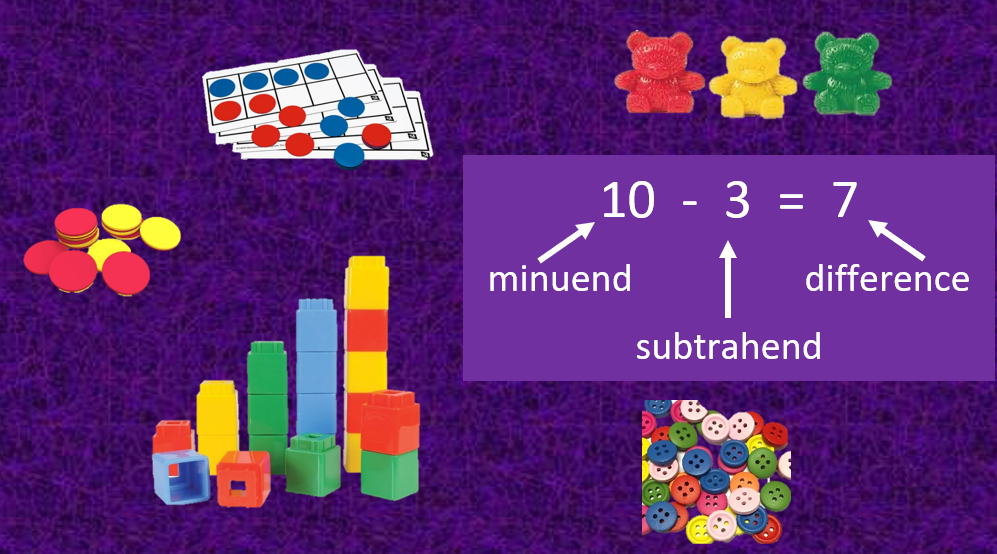
Students start experience subtraction through the utilize of models. They may use a variety of manipulatives such as cubes, counting bears, buttons, five and ten frames, fingers, or counters. Students may also draw representations or pictures to model the mathematics or even act out the subtraction physically. These models help students understand the action happening in the earliest subtraction bug. Models can even so exist helpful as students work beyond office-part-total, change, and comparative subtraction bug. Students likewise need practise finding the missing values in all locations of a subtraction problem - the minuend, subtrahend, and the difference. For more than examples of subtraction problem situations, check out the Glossary Table i from the Common Core State Standards for Mathematics.
Counting Back (or Up)
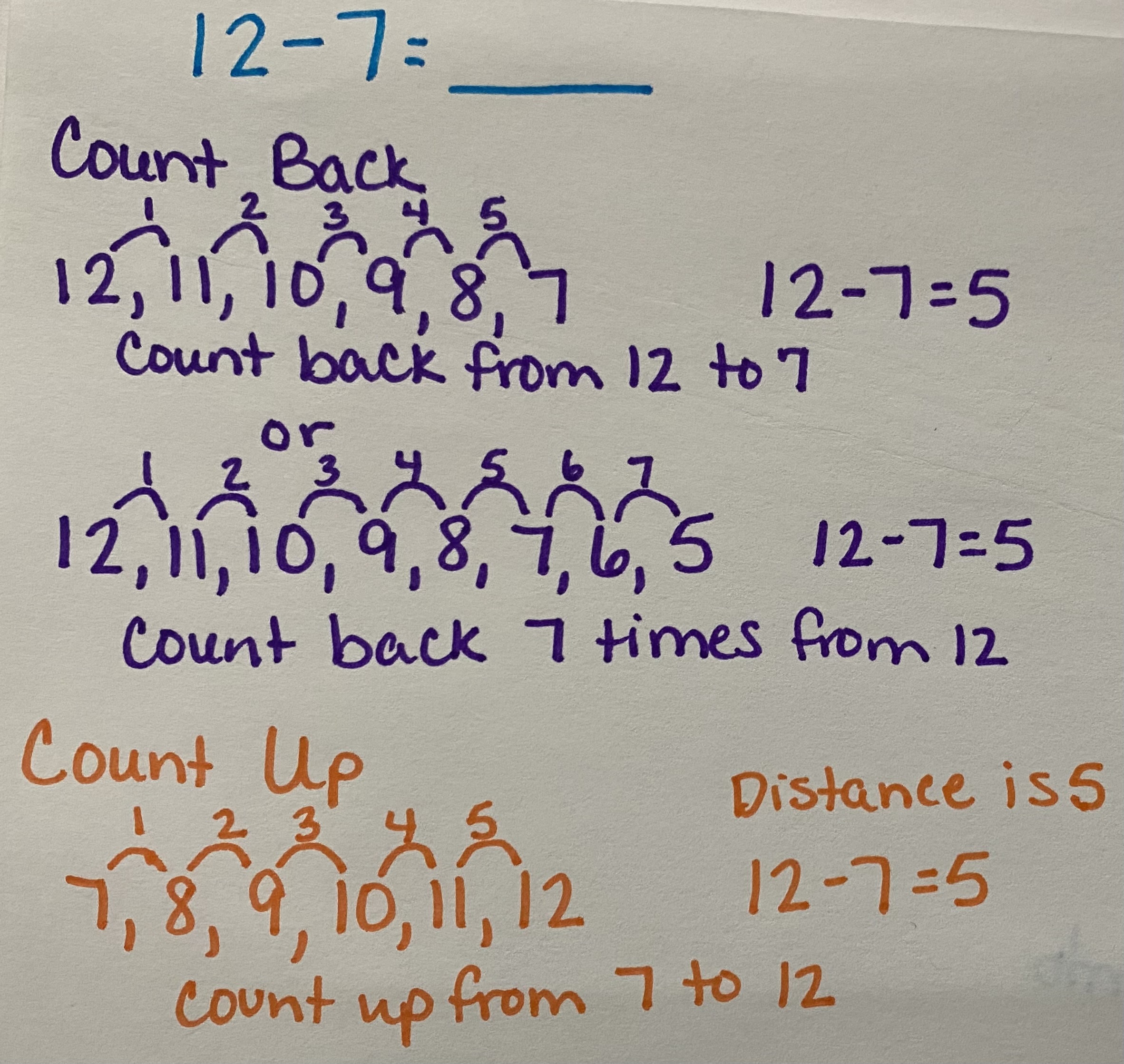
When using the strategy of counting dorsum or even counting up, it is of import to think that subtraction means the difference or distance between the minuend and subtrahend values. When your students empathise the relationship of the values and that they can either count back from the minuend or count up from the subtrahend, they deepen their understanding of number sense and how numbers piece of work together. The strategy of counting back or counting upwards tin can often be paired with a number line or an open up number line as the values worked with increase.
Number Grids
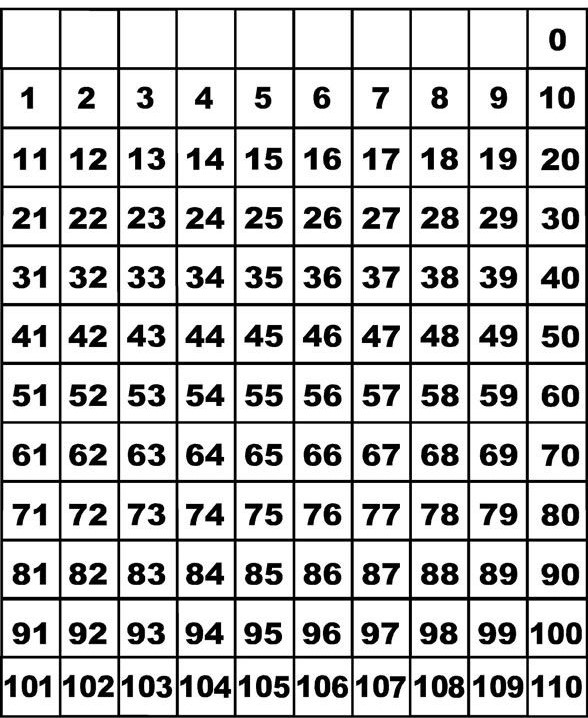
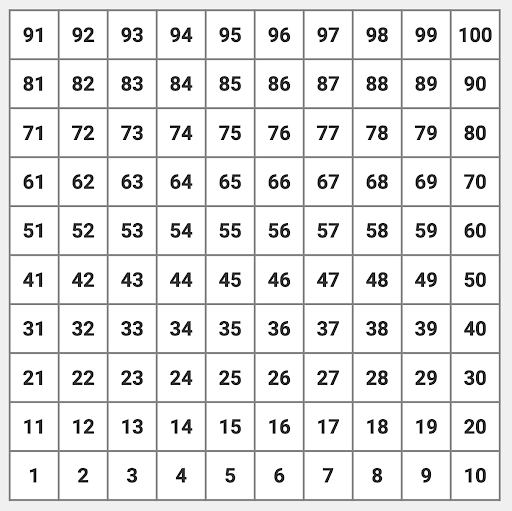
Number grids are a great way for students to look for patterns in subtraction. Information technology begins to build an understanding of place value as students begin looking at what they detect about the tens and ones places. Number grids are uniquely ready in rows of 10 to model our base x number arrangement. Equally students motility across a row, they should notice the digit in the tens place stays the same until the stop of the row and the ones place increases by 1. Equally they move up or downwardly a row, they should notice that the ones place stays the same and the digit in the tens place either increases or decreases past ane.
Please note the difference in these two number grid. Ane filigree goes from 0 to 110 acme to bottom while the other goes from one to 100 lesser to height. The ane on the left is more ordinarily used in the classroom, nevertheless the one on the correct more accurately matched a pupil'south actions of addition or subtraction. As students counts up in add-on, the numbers go upward the chart. Equally a pupil counts back in subtraction, the numbers go downwardly the chart.
Base 10 Blocks
Base ten blocks are a tool utilized many ways in mathematics. In this case, we will be using the base ten blocks representing hundreds, tens, and ones to show the activeness of subtraction or taking away from one group. Students should start with building representations of the minuend (the number being taken away from), then taking from the minuend, the value of the subtrahend (the number existence subtracted), leaving backside the difference. As students larn this strategy, starting time with numbers where breaking apart groups is not needed. Every bit students become familiar with the action of subtracting, begin the discussions of individual digits in a place value, explore what students recollect you could do well-nigh not having enough in i particular identify value. Students can then model making fair trades. As students become more than comfortable with the physical manipulatives, motion into the visual representation or sketch of the base ten blocks. Teach students that they exercise not have to draw out individual units, but employ "autograph" sketches of the base x blocks (a foursquare for the hundreds, a line for the tens, and a dot for the ones). Students tin then chronicle their models to the more abstruse standard algorithm for subtraction. This progression of learning is modeled in the video.
Open Number Line
Nosotros are all familiar with the number line that young children use. Typically it begins at zero with and counts up by one. An open up number line is a bare number line that can be used for whatsoever values along the number line that would be useful in solving issues. Typically tick marks are not included on the open number line and every bit number are added to the number line, they may not be to calibration. The open number line is useful in making a representation to tape steps of mental ciphering. Scout the video to see an example of how to use open number lines with subtraction.
Compensation/Give and Take (Constant Differences)
Compensation is a strategy, oftentimes carried out in mental math, where one or more than numbers is adjusted to brand easier-to-utilize numbers for mental math. For case some value may be taken from or added to either the minuend or subtrahend and then the difference is adjusted to make the problem easier to solve. In the problem 59 - 32, 59 is only ane away from lx and threescore would be easier to decrease from than the 59, and breaking 32 into thirty and two will besides brand mental subtraction easier, giving the states the problem 60 - 30 - ii. sixty - 30 = 30, 30 - ii = 28. Now nosotros need to adjust the problem for the boosted 1 we started with, and then 28 - 1 = 27. Another way to solve this same problem using constant differences is to exercise the same to each the minuend and the subtrahend virtually moving it's location on a number line. Think of the distance between 32 and 59 on a number line, adding ane to each value, making the the same distance, now it is the distance between 33 and 60; the problems are equivalent merely in a different location on the number line. Building number sense and using the relationship of place values and digits, allows usa to deepen our agreement of the operations.
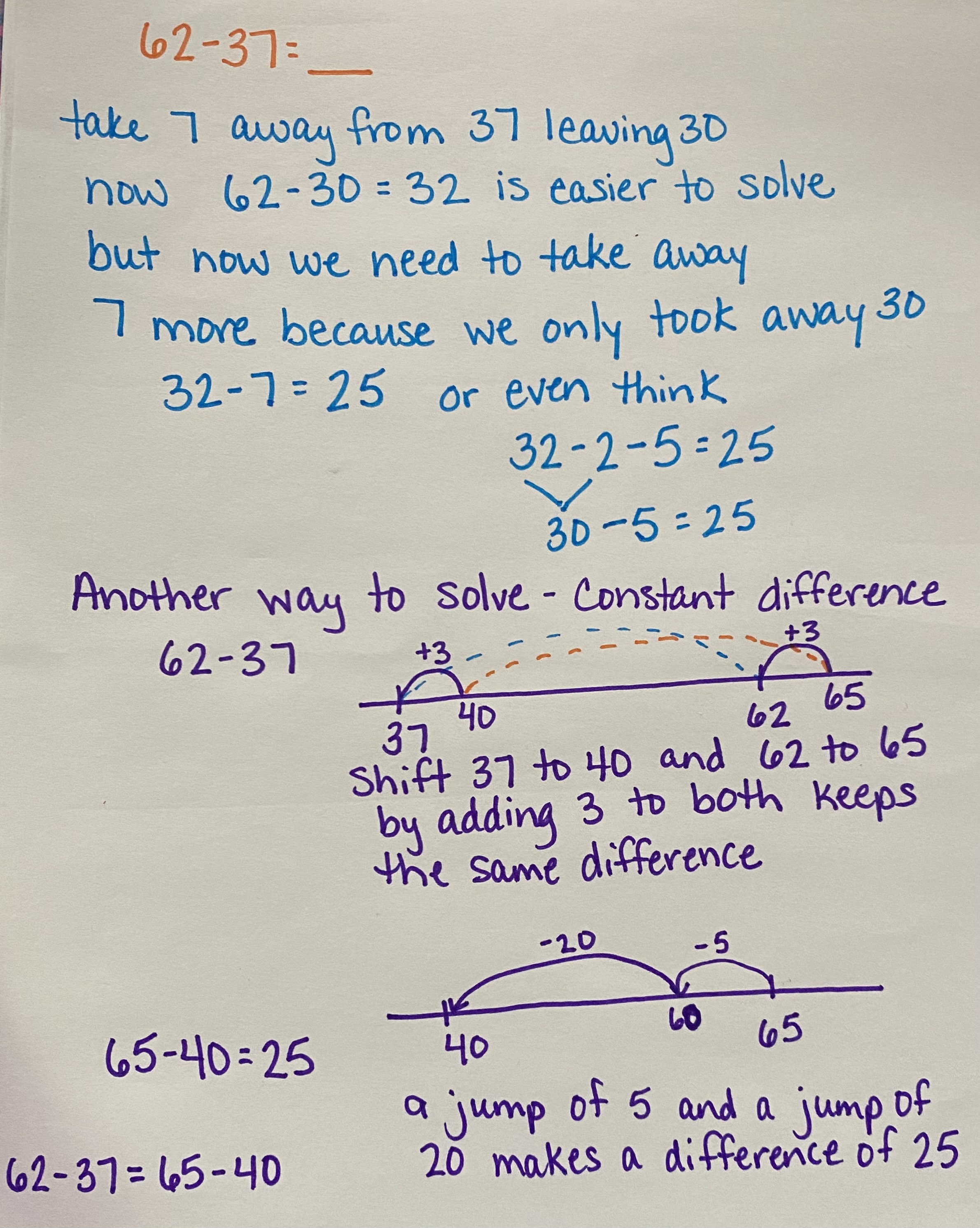
Compensation decomposes (takes apart) or recomposes (puts dorsum together) numbers to make subtraction easier to solve mentally. Students need to sympathise how numbers tin be broken apart and put back together to strengthen their number sense skills.
Expanded Annotation (Regroup)
Expanded notation utilizes place value to subtract within each place value, so brings the expanded notation dorsum together to make the terminal divergence. Within expanded notation one place value can be regrouped when necessary to decrease within a place value.
Usa Standard Algorithm
The US standard algorithm for subtraction is the strategy nigh adults remember of when asked to decrease numbers - stack and subtract. Historically, it is a set up of procedures that we were taught in our own schooling. It is an efficient strategy, only it is strictly procedural. When students can utilize more conceptual strategies to build their understanding of subtraction, they then can connect the procedures to that conceptual agreement. Mastery of the standard algorithm is expected by the stop of form iv, notwithstanding students will be introduced to this strategy much earlier as they are connecting strategies to build deeper knowledge.
Graham Fletcher Video - Progression of Addition and Subtraction
To learn more about the early numeracy or the progression of addition, multiplication, or sectionalization strategies or to find other mathematics pedagogy learning modules click here.

Break Apart Strategy For Subtraction,
Source: https://www.maine.gov/doe/pl/math/subtraction
Posted by: hobbsenee1983.blogspot.com
0 Response to "Break Apart Strategy For Subtraction"
Post a Comment