

Area Of Parallelogram Given Vertices
Area of Parallelogram
The surface area of a parallelogram is defined equally the region or space covered by a parallelogram in a two-dimensional plane. A parallelogram is a special kind of quadrilateral. If a quadrilateral has two pairs of parallel opposite sides, then information technology is called a parallelogram. Rectangle, square, and rhomb are all examples of a parallelogram. Geometry is all almost shapes, 2d or 3D. All of these shapes accept a dissimilar set of properties with different formulas for area. The prime focus here volition exist entirely on the following:
- Definition of the expanse of a parallelogram
- Formula of the area of a parallelogram
- Adding of a parallelogram's area in vector form
| i. | What Is the Area of Parallelogram? |
| 2. | Area of Parallelogram Formula |
| 3. | How To Calculate the Area of Parallelogram? |
| four. | Area of Parallelogram in Vector Form |
| five. | FAQs on Area of Parallelogram |
What Is the Area of Parallelogram?
The area of a parallelogram refers to the total number of unit of measurement squares that can fit into information technology and information technology is measured in square units (similar cmtwo, m2, intwo, etc). It is the region enclosed or encompassed by a parallelogram in 2-dimensional space. Permit the states recall the definition of a parallelogram. A parallelogram is a four-sided, ii-dimensional figure with:
- two equal, opposite sides,
- two intersecting and non-equal diagonals, and
- opposite angles that are equal
We come up across many geometric shapes other than rectangles and squares in our daily lives. Since few properties of a rectangle and the parallelogram are somewhat similar, the area of the rectangle is similar to the area of a parallelogram.
Area of a Parallelogram Formula
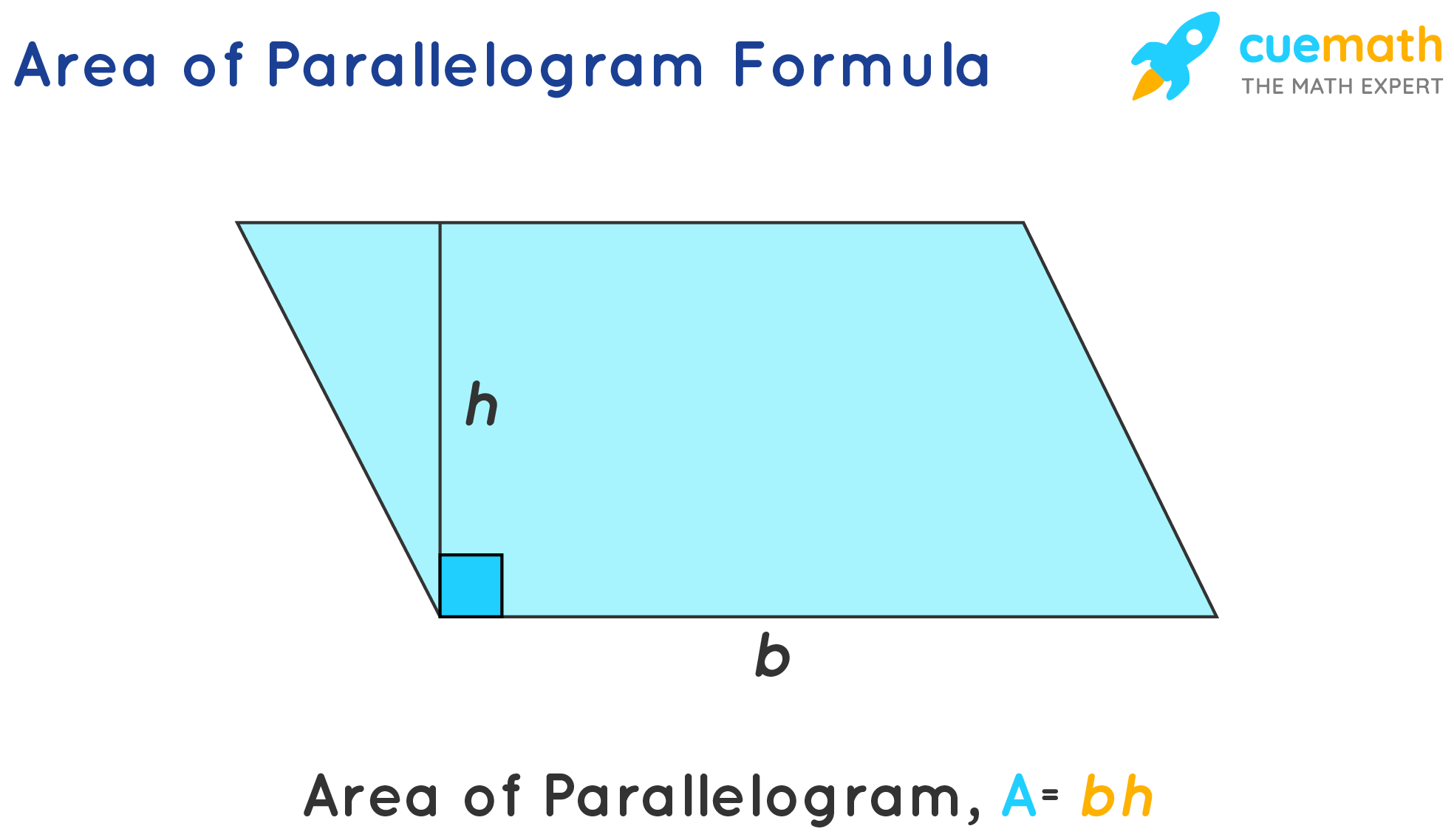
The surface area of a parallelogram can be calculated by multiplying its base of operations with the altitude. The base and altitude of a parallelogram are perpendicular to each other equally shown in the post-obit figure. The formula to calculate the area of a parallelogram can thus be given as,
Area of parallelogram = b × h square units
where,
- b is the length of the base
- h is the height or altitude
Let u.s.a. clarify the above formula using an example. Assume that PQRS is a parallelogram. Using grid paper, allow u.s.a. find its area by counting the squares.

From the higher up figure:
Total number of complete squares = 16
Full number of one-half squares = viii
Expanse = 16 + (1/2) × 8 = xvi + 4 = 20 unit2
Also, we observe in the figure that ST ⊥ PQ. By counting the squares, we go:
Side, PQ = v units
Respective height, ST=iv units
Side × height = 5 × 4 = xx unittwo
Thus, the area of the given parallelogram is base times the altitude.
Permit's exercise an activeness to empathise the area of a parallelogram.
- Step I: Describe a parallelogram (PQRS) with altitude (SE) on a cardboard and cutting it.
- Step Ii: Cut the triangular portion (PSE).
- Step III: Paste the remaining portion (EQRS) on a white chart.
- Step IV: Paste the triangular portion (PSE) on the white chart joining sides RQ and SP.

Later doing this activity, we observed that the surface area of a rectangle is equal to the area of a parallelogram. Also, the base and height of the parallelogram are equal to the length and breadth of the rectangle respectively.
Area of Parallelogram = Base of operations × Summit
How To Calculate Area of a Parallelogram?
The parallelogram expanse can exist calculated with the help of its base and height. Also, the area of a parallelogram can likewise exist evaluated if its two diagonals forth with whatever of their intersecting angles are known, or if the length of the parallel sides along with any of the angles between the sides is known.
Parallelogram Area Using Height
Suppose 'a' and 'b' are the set up of parallel sides of a parallelogram and 'h' is the superlative (which is the perpendicular distance between 'a' and 'b'), then the area of a parallelogram is given by:
Area = Base × Summit
A = b × h [square units]
Example: If the base of a parallelogram is equal to v cm and the height is 4 cm, then find its area.
Solution: Given, length of base = 5 cm and height = four cm
As per the formula, Area = five × 4 = 20 cm2
Parallelogram Expanse Using Lengths of Sides
The area of a parallelogram can too be calculated without the height if the length of next sides and bending between them are known to us. Nosotros tin simply use the expanse of the triangle formula from the trigonometry concept for this case.
Area = ab sin (θ)
where,
- a and b = length of parallel sides, and,
- θ = angle between the sides of the parallelogram.
Example: The angle betwixt any two sides of a parallelogram is 90 degrees. If the length of the two parallel sides is iv units and vi units respectively, then detect the area.
Solution:
Let a = 4 units and b = 6 units
θ = 90 degrees
Using expanse of parallelogram formula,
Area = ab sin (θ)
⇒ A = 4 × 6 sin (90º)
⇒ A = 24 sin 90º
⇒ A = 24 × ane = 24 sq.units.
Notation: If the angle betwixt the sides of a parallelogram is 90 degrees, so the parallelogram becomes a rectangle.
Parallelogram Area Using Diagonals
The surface area of whatsoever given parallelogram can also be calculated using the length of its diagonals. There are ii diagonals for a parallelogram, intersecting each other at sure angles. Suppose, this angle is given by 10, then the area of the parallelogram is given by:
Expanse = ½ × d\(_1\) × d\(_2\) sin (10)
where,
- d\(_1\) and d\(_2\) = Length of diagonals of the parallelogram, and
- ten = Angle between the diagonals.
Area of Parallelogram in Vector Form
The area of the parallelogram can exist calculated using dissimilar formulas even when either the sides or the diagonals are given in the vector form. Consider a parallelogram ABCD as shown in the figure below,

Area of parallelogram in vector form using the adjacent sides is,
\(|\overrightarrow{\mathrm{a}} × \overrightarrow{\mathrm{b}}|\)
where, \(\overrightarrow{a}\) and \(\overrightarrow{b}\) are vectors representing 2 adjacent sides.
Here,
\(\overrightarrow{a} + \overrightarrow{b} = \overrightarrow{d_1} \) → i) and,
\(\overrightarrow{b} + (-\overrightarrow{a}) = \overrightarrow{d_2} \)
or, \(\overrightarrow{b} - \overrightarrow{a} = \overrightarrow{d_2}\) → ii)
⇒ \( \overrightarrow{d_1} \times \overrightarrow{d_2} = (\overrightarrow{a} + \overrightarrow{b}) (\overrightarrow{b} - \overrightarrow{a})\)
= \(\overrightarrow{a}\) × (\(\overrightarrow{b}\) - \(\overrightarrow{a}\)) + \(\overrightarrow{b}\) × (\(\overrightarrow{b}\) - \(\overrightarrow{a}\))
= \(\overrightarrow{a}\) × \(\overrightarrow{b}\) - \(\overrightarrow{a}\) × \(\overrightarrow{a}\) + \(\overrightarrow{b}\) × \(\overrightarrow{b}\) - \(\overrightarrow{b}\) × \(\overrightarrow{a}\)
Since \(\overrightarrow{a}\) × \(\overrightarrow{a}\) = 0, and \(\overrightarrow{b}\) × \(\overrightarrow{b}\) = 0
⇒ \(\overrightarrow{a}\) × \(\overrightarrow{b}\) - 0 + 0 - \(\overrightarrow{b}\) × \(\overrightarrow{a}\)
Since \(\overrightarrow{a}\) × \(\overrightarrow{b}\) = - \(\overrightarrow{b}\) × \(\overrightarrow{a}\),
\( \overrightarrow{d_1}\) × \(\overrightarrow{d_2}\) = \(\overrightarrow{a}\) × \(\overrightarrow{b}\) - (-(\(\overrightarrow{a}\) × \(\overrightarrow{b}\)))
= 2(\(\overrightarrow{a}\) × \(\overrightarrow{b}\))
Therefore, area of parallelogram when diagonals are given in vector grade = i/two |(\(\overrightarrow{d_1}\) × \(\overrightarrow{d_2}\))|
where, \(\overrightarrow{d_1}\) and \(\overrightarrow{d_2}\) are diagonals.
Thinking Out Of the Box!
- Can a kite exist called a parallelogram?
- What elements of a trapezoid should be changed to brand it a parallelogram?
- Tin there exist a concave parallelogram?
- Can you discover the area of the parallelogram without knowing its pinnacle?
Area of Parallelogram Examples
-
Example 1: The next sides of a parallelogram are ten in and 6 in. The altitude respective to side 10 in is 5 in. Using the area of parallelogram formula, observe the area and the length of the distance corresponding to its adjacent side.

Solution:
Allow ABCD exist a parallelogram where DE⊥AB, AF⊥BC
Using the surface area of parallelogram formula,
Expanse of Parallelogram ABCD = (10) × (v) = 50 in2
Length of BC = six in
Length of Altitude AF = (50 ÷ 6) = 8.3 inRespond: Surface area of the given parallelogram = l intwo; Altitude = 8.3 in
get to slidego to slidego to slide

Have questions on basic mathematical concepts?
Become a problem-solving gnaw using logic, not rules. Learn the why behind math with ourCuemath's certified experts.
Book a Gratuitous Trial Class
Practice Questions on Area of Parallelogram
go to slidego to slide
FAQs on Area of Parallelogram
What Is the Area of a Parallelogram in Math?
The area of a parallelogram is defined as the region enclosed or encompassed past a parallelogram in ii-dimensional space. It is represented in square units like cmii, mii, intwo, etc.
How To Find Area of a Parallelogram Without Elevation?
The expanse of a parallelogram can be calculated without the top when the length of adjacent sides and the angle between them is known. The formula to find the area for this example is given as, area = ab sin (θ), where 'a' and 'b' are lengths of adjacent sides, and, θ is the angle between them.
Also, the expanse tin be calculated when the diagonals and their intersecting angle are given, using the formula, Area = ½ × d1 × d2 sin (y), where 'd1' and 'd2' are lengths of diagonals of the parallelogram, and 'y' is the angle between them.
What Is the Formula of Finding Area of Parallelogram?
The area of a parallelogram tin exist calculated by finding the production of its base with the altitude. The base and distance of a parallelogram are always perpendicular to each other. The formula to calculate the area of a parallelogram is given equally Area of parallelogram = base of operations × summit foursquare units.
How To Find Area of Parallelogram With Vectors?
Area of a parallelogram can be calculated when the next sides or diagonals are given in the vector form. The formula to find surface area using vector adjacent sides is given as, | \(\overrightarrow{a}\) × \(\overrightarrow{b}\)|, where \(\overrightarrow{a}\) and \(\overrightarrow{b}\) are adjacent side vectors. As well, the expanse of parallelogram formula using diagonals in vector form is, area = 1/2 |(\(\overrightarrow{d_1}\) × \(\overrightarrow{d_2}\))|, where \(\overrightarrow{d_1}\) and \(\overrightarrow{d_2}\) are diagonal vectors.
How to Summate Surface area of Parallelogram Using Calculator?
To determine the expanse of a parallelogram the easiest and fastest method is to use the area of a parallelogram estimator. It is a free online tool that helps y'all to calculate the surface area of a parallelogram with the assistance of the given dimensions. Try now Cuemath's area of parallelogram calculator, enter the value of top and base of the parallelogram and get the parallelogram's area within a few seconds.
What Is the Area of a Parallelogram When Diagonals are Given?
The area of a parallelogram can be calculated when the diagonals and their intersecting angle are known. The formula is given every bit, area = ½ × d1 × d2 sin (x), where 'd1' and 'd2' are lengths of diagonals of the parallelogram, and 'ten' is the angle between them.
How To Calculate Area of Parallelogram Whose Adjacent Sides are Given?
To find the surface area of a parallelogram when the lengths of adjacent sides are given, nosotros demand the bending betwixt them. The formula to find the surface area for this example is given as, area = ab sin (θ), where 'a' and 'b' are lengths of adjacent sides, and, θ is the angle between the sides of the parallelogram.

Area Of Parallelogram Given Vertices,
Source: https://www.cuemath.com/measurement/area-of-parallelogram/
Posted by: hobbsenee1983.blogspot.com
0 Response to "Area Of Parallelogram Given Vertices"
Post a Comment