

Antimony Iii Oxide Molar Mass
 | |
| Names | |
|---|---|
| IUPAC name Antimony(Three) oxide | |
| Other names Antimony sesquioxide | |
| Identifiers | |
| CAS Number |
|
| 3D model (JSmol) |
|
| ChemSpider |
|
| ECHA InfoCard | 100.013.796 |
| EC Number |
|
| KEGG |
|
| PubChem CID |
|
| RTECS number |
|
| UNII |
|
| CompTox Dashboard (EPA) |
|
| InChI
| |
| SMILES
| |
| Properties | |
| Chemical formula | Sb2Oiii |
| Molar mass | 291.518 m/mol |
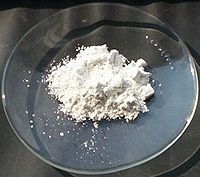
| Appearance | white solid |
| Odour | odorless |
| Density | 5.ii g/cm3, α-form 5.67 thousand/cmiii β-class |
| Melting point | 656 °C (1,213 °F; 929 Grand) |
| Humid point | 1,425 °C (two,597 °F; 1,698 Chiliad) (sublimes) |
| Solubility in water | 370 ± 37 µg/Fifty between 20.8°C and 22.ix°C |
| Solubility | soluble in acid |
| Magnetic susceptibility (χ) | -69.4·x−6 cm3/mol |
| Refractive index (north D) | 2.087, α-grade ii.35, β-form |
| Structure | |
| Crystal structure | cubic (α)<570 °C orthorhombic (β) >570 °C |
| Coordination geometry | pyramidal |
| Dipole moment | zero |
| Hazards | |
| GHS labelling: | |
| Pictograms |  [i] [i] |
| Point give-and-take | Warning [ane] |
| Hazard statements | H351 [one] |
| Precautionary statements | P281 [one] |
| NFPA 704 (burn down diamond) | two 0 0 |
| Lethal dose or concentration (LD, LC): | |
| LDfifty (median dose) | 7000 mg/kg, oral (rat) |
| NIOSH (Us health exposure limits): | |
| PEL (Permissible) | TWA 0.v mg/chiliad3 (as Sb)[2] |
| REL (Recommended) | TWA 0.5 mg/m3 (every bit Sb)[ii] |
| Related compounds | |
| Other anions | Antimony trisulfide Antimony triselenide Antimony telluride |
| Other cations | Dinitrogen trioxide Phosphorus trioxide Arsenic trioxide Bismuth trioxide |
| Related compounds | Diantimony tetraoxide Antimony pentoxide |
| Supplementary data page | |
| Antimony trioxide (data page) | |
| Except where otherwise noted, data are given for materials in their standard land (at 25 °C [77 °F], 100 kPa). Infobox references | |


Antimony(Iii) oxide is the inorganic chemical compound with the formula Sb2O3. Information technology is the near important commercial chemical compound of antimony. Information technology is constitute in nature as the minerals valentinite and senarmontite.[iii] Like most polymeric oxides, Sb2Othree dissolves in aqueous solutions with hydrolysis. A mixed arsenic-antimony oxide occurs in nature every bit the very rare mineral stibioclaudetite.[four] [five]
Production and backdrop [edit]
Global production of antimony(Iii) oxide in 2012 was 130,000 tonnes, an increase from 112,600 tonnes in 2002. People's republic of china produces the largest share followed by United states/Mexico, Europe, Japan and Due south Africa and other countries (2%).[half dozen]
Every bit of 2010, antimony(Iii) oxide was produced at iv sites in EU27. Information technology is produced via two routes, re-volatilizing of rough antimony(III) oxide and past oxidation of antimony metal. Oxidation of antimony metallic dominates in Europe. Several processes for the product of crude antimony(III) oxide or metallic antimony from virgin fabric. The pick of process depends on the limerick of the ore and other factors. Typical steps include mining, crushing and grinding of ore, sometimes followed by froth flotation and separation of the metallic using pyrometallurgical processes (smelting or roasting) or in a few cases (east.g. when the ore is rich in precious metals) past hydrometallurgical processes. These steps do not take place in the Eu but closer to the mining location.
Re-volatilizing of crude antimony(III) oxide [edit]
Step i) Rough stibnite is oxidized to crude antimony(III) oxide using furnaces operating at approximately 500 to 1,000 °C. The reaction is the following:
- two Sb2Siii + 9 O2 → 2 Sb2Oiii + 6 Sotwo
Step two) The crude antimony(Three) oxide is purified by sublimation.
Oxidation of antimony metal [edit]
Antimony metallic is oxidized to antimony(Iii) oxide in furnaces. The reaction is exothermic. Antimony(3) oxide is formed through sublimation and recovered in purse filters. The size of the formed particles is controlled by process conditions in furnace and gas flow. The reaction can be schematically described by:
- 4 Sb + 3 O2 → ii Sb2O3
Properties [edit]
Antimony(III) oxide is an amphoteric oxide. Information technology dissolves in aqueous sodium hydroxide solution to requite the meta-antimonite NaSbO2, which can be isolated equally the trihydrate. Antimony(III) oxide also dissolves in concentrated mineral acids to requite the corresponding salts, which hydrolyzes upon dilution with h2o.[7] With nitric acid, the trioxide is oxidized to antimony(V) oxide.[viii]
When heated with carbon, the oxide is reduced to antimony metal. With other reducing agents such as sodium borohydride or lithium aluminium hydride, the unstable and very toxic gas stibine is produced.[nine] When heated with potassium bitartrate, a circuitous salt potassium antimony tartrate, KSb(OH)2•C4H2Ovi, is formed.[8]
Structure [edit]
The structure of Sb2O3 depends on the temperature of the sample. Dimeric SbivO6 is the high temperature (1560 °C) gas.[x] SbfourO6 molecules are bicyclic cages, similar to the related oxide of phosphorus(Three), phosphorus trioxide.[11] The cage structure is retained in a solid that crystallizes in a cubic habit. The Sb-O altitude is 197.7 pm and the O-Sb-O angle of 95.6°.[12] This form exists in nature as the mineral senarmontite.[11] To a higher place 606 °C, the more stable form is orthorhombic, consisting of pairs of -Sb-O-Sb-O- chains that are linked by oxide bridges betwixt the Sb centers. This class exists in nature as the mineral valentinite.[xi]
Uses [edit]
The annual consumption of antimony(3) oxide in the United States and Europe is approximately 10,000 and 25,000 tonnes, respectively. The chief application is equally flame retardant synergist in combination with halogenated materials. The combination of the halides and the antimony is key to the flame-retardant action for polymers, helping to course less flammable chars. Such flame retardants are found in electric apparatuses, textiles, leather, and coatings.[13]
Other applications:
- Antimony(III) oxide is an opacifying agent for glasses, ceramics and enamels.
- Some specialty pigments contain antimony.
- Antimony(III) oxide is a useful catalyst in the product of polyethylene terephthalate (PET plastic) and the vulcanization of rubber.
Safety [edit]
Antimony(III) oxide has suspected carcinogenic potential for humans.[13] Its TLV is 0.5 mg/yardthree, as for most antimony compounds.[14] No other man wellness hazards were identified for antimony(Three) oxide, and no risks to human health and the environs were identified from the product and apply of antimony trioxide in daily life.
References [edit]
- ^ a b c d Record of Antimony trioxide in the GESTIS Substance Database of the Constitute for Occupational Safety and Health, accessed on 23 Baronial 2017.
- ^ a b NIOSH Pocket Guide to Chemical Hazards. "#0036". National Institute for Occupational Prophylactic and Wellness (NIOSH).
- ^ Greenwood, Due north. North.; & Earnshaw, A. (1997). Chemistry of the Elements (2nd Edn.), Oxford:Butterworth-Heinemann. ISBN 0-7506-3365-4.
- ^ "Stibioclaudetite".
- ^ "List of Minerals". 21 March 2011.
- ^ "Archived copy" (PDF). Archived from the original (PDF) on 2014-01-06. Retrieved 2014-01-06 .
{{cite web}}: CS1 maint: archived copy as championship (link) - ^ Housecroft, C. E.; Sharpe, A. Chiliad. (2008). "Chapter 15: The group fifteen elements". Inorganic Chemistry (tertiary ed.). Pearson. p. 481. ISBN978-0-13-175553-half dozen.
- ^ a b Patnaik, P. (2002). Handbook of Inorganic Chemicals. McGraw-Hill. p. 56. ISBN0-07-049439-8.
- ^ Bellama, J. M.; MacDiarmid, A. Thou. (1968). "Synthesis of the Hydrides of Germanium, Phosphorus, Arsenic, and Antimony past the Solid-Phase Reaction of the Respective Oxide with Lithium Aluminum Hydride". Inorganic Chemistry. 7 (10): 2070–2072. doi:10.1021/ic50068a024.
- ^ Wiberg, Due east.; Holleman, A. F. (2001). Inorganic Chemistry. Elsevier. ISBN0-12-352651-v.
- ^ a b c Wells, A. F. (1984). Structural Inorganic Chemical science. Oxford: Clarendon Press. ISBN0-19-855370-6.
- ^ Svensson, C. (1975). "Refinement of the crystal structure of cubic antimony(III) oxide, Sb2O3". Acta Crystallographica B. 31 (8): 2016–2018. doi:10.1107/S0567740875006759.
- ^ a b Grund, Due south. C.; Hanusch, K.; Breunig, H. J.; Wolf, H. U. "Antimony and Antimony Compounds". Ullmann's Encyclopedia of Industrial Chemical science. Weinheim: Wiley-VCH. doi:x.1002/14356007.a03_055.pub2.
- ^ Newton, P. East.; Schroeder, R. E.; Zwick, L.; Serex, T. (2004). "Inhalation Developmental Toxicity Studies In Rats With Antimony(III) oxide (Sb2O3)". Toxicologist. 78 (i–S): 38.
Further reading [edit]
- Institut national de recherche et de sécurité (INRS), Fiche toxicologique nº 198 : Trioxyde de diantimoine, 1992.
- The Oxide Handbook, Thousand.5. Samsonov, 1981, 2nd ed. IFI/Plenum, ISBN 0-306-65177-vii
External links [edit]
- International Antimony Association
- International Chemical Safe Card 0012
- Antimony Market place And Toll
- Société industrielle et chimique de l'Aisne

Antimony Iii Oxide Molar Mass,
Source: https://en.wikipedia.org/wiki/Antimony_trioxide
Posted by: hobbsenee1983.blogspot.com
0 Response to "Antimony Iii Oxide Molar Mass"
Post a Comment